
When Characters Refuse to Stay on the Page
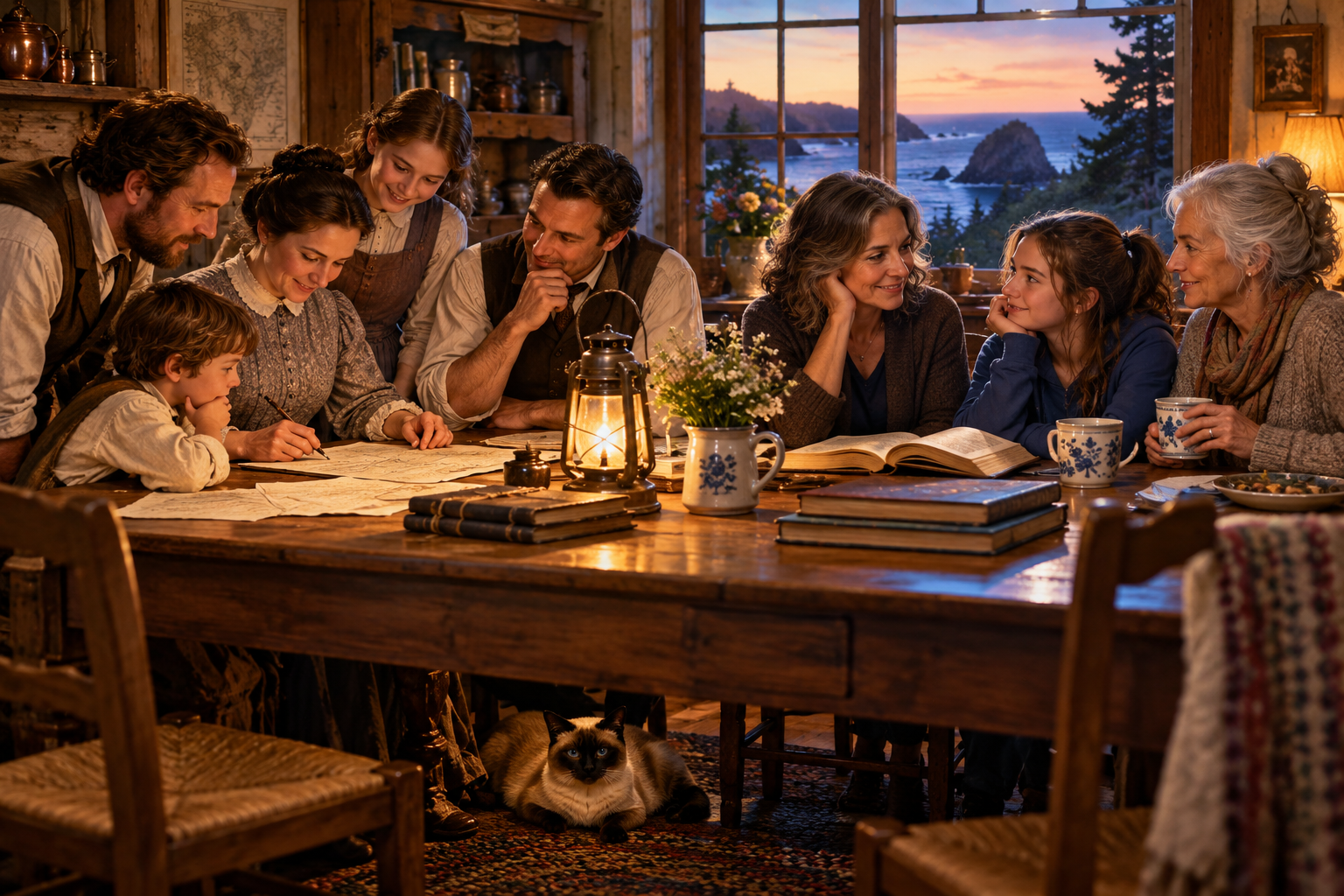
Families from two centuries gather around a wooden table, sharing stories and laughter, while a Siamese cat rests beneath them.
One of the unexpected pleasures of writing fiction is discovering that the people you invent don't always behave like people you've invented.
At first, they're wonderfully cooperative. You give them names, decide what they look like, provide them with a little history, and assign them a role in the story. They appear when needed, say what they're supposed to say, and disappear when their part is finished.
Or so you think.
Somewhere along the way, they begin developing opinions.
A character who was meant to appear in only a scene or two becomes someone you want to know better. Another develops an unexpected friendship. Someone you thought you understood reveals a side of herself you hadn't considered.
And occasionally, a character looks at the words you've put in his mouth and seems to say, I would never say that.
This is one of the reasons I enjoy returning to Alderhaven.
When I began writing the Seraphina Beckett Cozy Mysteries, I knew something about the town I wanted to create. I wanted a place where people cared about one another, where kindness was a strength rather than a weakness, and where the mysteries involved human lives as much as the circumstances that had disrupted them.
What I didn't fully anticipate was how attached I would become to the people who lived there.
Marion Steele, for example, has become much more than a wise and dependable friend. She has a lifetime of experiences behind her, memories that shape her understanding of others, and a quiet strength that doesn't require her to announce itself.
Callie Monroe arrived in Alderhaven with more questions than answers. Watching her discover her family, her abilities, and her own possibilities has been one of the great pleasures of writing these books. And her story isn't finished simply because one mystery has been solved.
Beatrix, too, has reminded me that finding someone is not the same as restoring everything that has been lost. Some things take time, patience, and the willingness to begin again.
Even the people who appear less frequently have lives that continue when they aren't occupying a chapter. I sometimes find myself wondering what they're doing while Sera is busy investigating something else.
Of course, this creates a small problem for their author.
The more I know about these people, the less willing I am to make them do something merely because it would be convenient for the plot.
They have to behave like themselves.
Lately, I've been spending time with another group of characters: the families who will eventually establish Alderhaven in the nineteenth century.
Writing The Founders’ Light has given me the opportunity to imagine the people whose convictions, disagreements, humor, hardships, and everyday decisions helped shape the town Sera and Callie now call home.
What interests me most isn't simply what these families believed. It's how those beliefs might have influenced the way they treated their children, welcomed strangers, worked together, and faced circumstances they hadn't anticipated.
And, being families, I suspect they occasionally disagreed about the best way to accomplish all of that.
I'm discovering that the people who build a community can be every bit as interesting as the people who inherit it.
Perhaps that's what I love most about writing a series. A story may end, but the characters don't have to disappear. They can grow older, make mistakes, change their minds, discover new interests, and surprise both their author and their readers.
Sometimes they even surprise me by being wiser than I intended.
I suppose that's only fair.
After all, I gave them their lives. The least I can do is let them live them.
I'd love to know: Have you ever finished a book and found yourself wondering what happened to a character afterward?