
When Characters Refuse to Stay on the Page
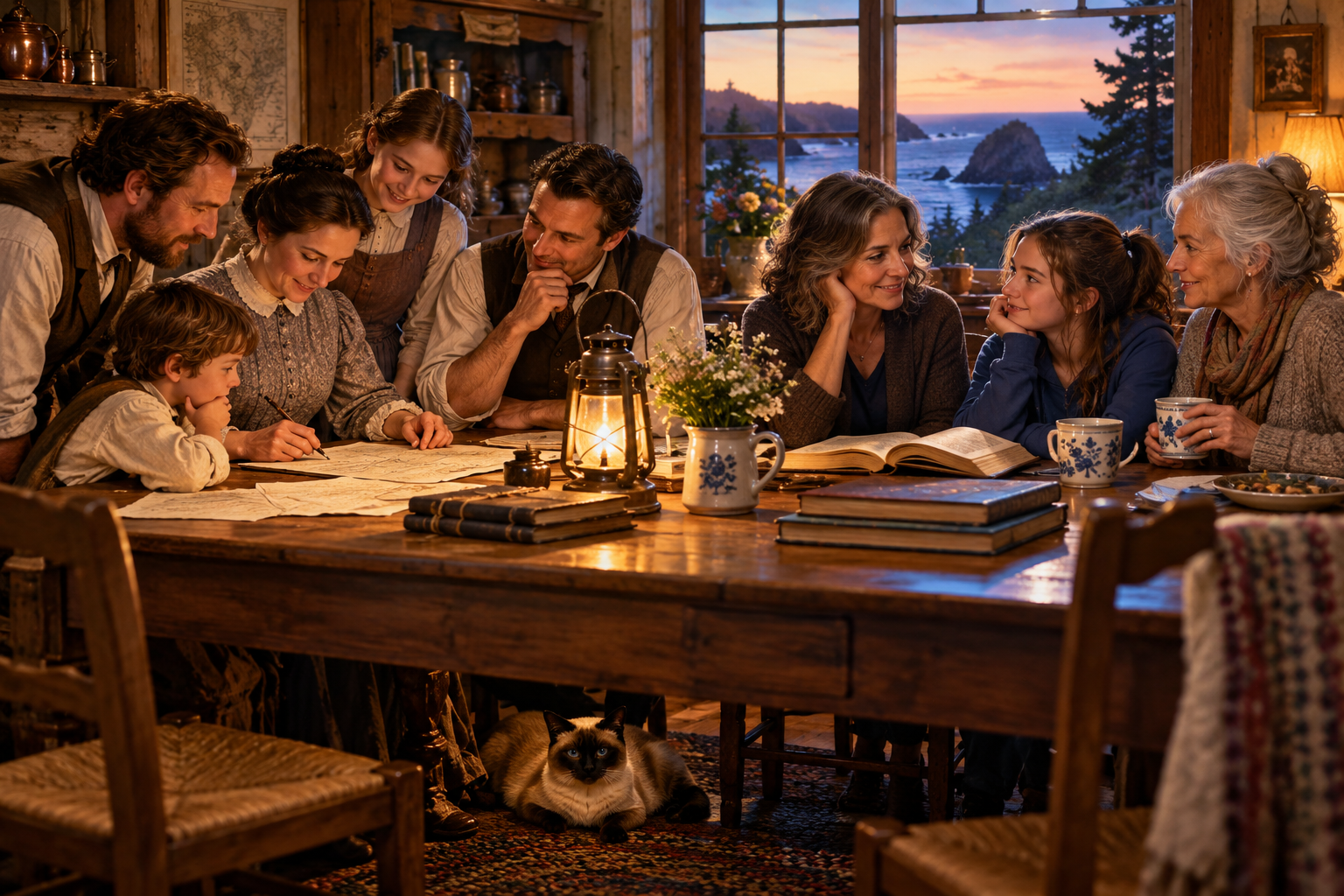
Families from two centuries gather around a wooden table, sharing stories and laughter, while a Siamese cat rests beneath them.
One of the unexpected pleasures of writing fiction is discovering that the people you invent don't always behave like people you've invented.
At first, they're wonderfully cooperative. You give them names, decide what they look like, provide them with a little history, and assign them a role in the story. They appear when needed, say what they're supposed to say, and disappear when their part is finished.
Or so you think.
Somewhere along the way, they begin developing opinions.
A character who was meant to appear in only a scene or two becomes someone you want to know better. Another develops an unexpected friendship. Someone you thought you understood reveals a side of herself you hadn't considered.
And occasionally, a character looks at the words you've put in his mouth and seems to say, I would never say that.
This is one of the reasons I enjoy returning to Alderhaven.
When I began writing the Seraphina Beckett Cozy Mysteries, I knew something about the town I wanted to create. I wanted a place where people cared about one another, where kindness was a strength rather than a weakness, and where the mysteries involved human lives as much as the circumstances that had disrupted them.
What I didn't fully anticipate was how attached I would become to the people who lived there.
Marion Steele, for example, has become much more than a wise and dependable friend. She has a lifetime of experiences behind her, memories that shape her understanding of others, and a quiet strength that doesn't require her to announce itself.
Callie Monroe arrived in Alderhaven with more questions than answers. Watching her discover her family, her abilities, and her own possibilities has been one of the great pleasures of writing these books. And her story isn't finished simply because one mystery has been solved.
Beatrix, too, has reminded me that finding someone is not the same as restoring everything that has been lost. Some things take time, patience, and the willingness to begin again.
Even the people who appear less frequently have lives that continue when they aren't occupying a chapter. I sometimes find myself wondering what they're doing while Sera is busy investigating something else.
Of course, this creates a small problem for their author.
The more I know about these people, the less willing I am to make them do something merely because it would be convenient for the plot.
They have to behave like themselves.
Lately, I've been spending time with another group of characters: the families who will eventually establish Alderhaven in the nineteenth century.
Writing The Founders’ Light has given me the opportunity to imagine the people whose convictions, disagreements, humor, hardships, and everyday decisions helped shape the town Sera and Callie now call home.
What interests me most isn't simply what these families believed. It's how those beliefs might have influenced the way they treated their children, welcomed strangers, worked together, and faced circumstances they hadn't anticipated.
And, being families, I suspect they occasionally disagreed about the best way to accomplish all of that.
I'm discovering that the people who build a community can be every bit as interesting as the people who inherit it.
Perhaps that's what I love most about writing a series. A story may end, but the characters don't have to disappear. They can grow older, make mistakes, change their minds, discover new interests, and surprise both their author and their readers.
Sometimes they even surprise me by being wiser than I intended.
I suppose that's only fair.
After all, I gave them their lives. The least I can do is let them live them.
I'd love to know: Have you ever finished a book and found yourself wondering what happened to a character afterward?
Must a Mystery Have a Murder

Must a Mystery Have a Murder?
When I began The Forgotten Laugh, I gave Sera Beckett a mysterious arrival, a girl with missing memories, and a town with more questions than answers.
I did not give her a body.
For a cozy mystery writer, this may sound like forgetting to put the tea in the teapot. But Callie had arrived in Alderhaven without knowing enough about her past to tell Sera where she belonged. I wanted to know the answer too.
Who was she? What had happened to the people who knew her? And how could Sera help without deciding for Callie what her story ought to be?
Those questions kept me writing. They also gave Sera a reason to do what she does best: notice what others overlook, listen carefully, and keep asking when an answer does not quite fit.
Of course, she has help. Marion Steele knows a great deal about Alderhaven’s past. Sheriff Cross has questions of his own. And Simba is available to occupy any evidence that has been left in a warm patch of sunlight.
No one is murdered in The Forgotten Laugh. There is still a mystery to solve, and finding the truth matters enormously to the people living with it.
The Vanishing Road is different. A woman dies, and Sera and Cross must discover what happened. That investigation belongs in the story because a life has been lost. Her death cannot be set aside while everyone returns to their coffee.
It also raises questions that reach beyond the immediate investigation. Alderhaven has an older mystery, and some of the things people remember do not agree with the things they have been told. Sera follows the clues, but she pays attention to the people carrying them, too.
By The Lost Mother, Callie has learned more about her family. She still has questions that no record or clever deduction can answer for her. She has to meet people as they are now, decide what she wants to ask, and make sense of answers that may be more complicated than she hoped.
I think that is why I’m drawn to human mysteries. A person can stand right beside us and still have a story we do not know. Sometimes she has kept it private. Sometimes she has been unable to tell it. And sometimes we have been so certain we understood that we forgot to ask.
A murder gives an investigator an urgent question. I understand why so many mysteries begin there. But a missing memory, a long silence, or someone’s unexpected return can make me turn pages just as quickly. I want to know what happened. I also want to know what the characters will do once they find out.
That is the thread running through all three Alderhaven books. Sera looks for answers, Callie asks questions of her own, and the people around them occasionally discover that they knew less than they thought. Marion may be the exception. She would probably say she was simply waiting for everyone else to catch up.
If you’ve been curious about the series, The Forgotten Laugh is where Sera and Callie’s Alderhaven story begins. There is no body waiting on the first page. There is a girl with a past she cannot remember, and a question Sera cannot walk away from.
What kind of mystery keeps you turning pages, even when no crime has been committed? I’d love to hear your answer. You can write to me at info@megrydercozy.com.
When A Finished Book Isn't Finished

When a Finished Book Isn’t Finished
I thought The Vanishing Road was finished.
The story had a beginning, a middle, and an end. The mystery had been solved. The characters had survived what I put them through. I had read the manuscript more than once and made corrections along the way.
All it needed, I thought, was one final read-through.
That was several weeks and a great many corrections ago.
The trouble began when I noticed a phrase I had used several times. It wasn’t a bad phrase. In fact, I must have liked it very much because I kept using it. Something would be said, and then the meaning would “settle” over the room. A thought would “land.” A silence would become significant.
After a while, I began to suspect that nothing in Alderhaven could happen without settling somewhere.
Once I noticed that habit, I started finding other things.
A character left the Salt & Quill and suddenly appeared outside without walking to the door. Another character spoke during a scene even though she wasn’t there. Someone answered a question that no one had asked.
Then there were the characters who knew things they had not yet learned.
Callie’s story made this especially important. She remembers very little about her early childhood. That means I have to keep careful track of every name, place, and relationship she discovers. She cannot talk about someone before she knows that person exists. She cannot remember being sent away if she does not even know for certain that she once lived in Alderhaven.
Unfortunately, Callie occasionally knew more than she was supposed to know.
Perhaps she had read ahead.
Continuity problems appeared in less mysterious forms too. Five parkour lessons began sounding as though they had all happened after only one. Travel plans did not allow enough time for passports to arrive. People started conversations in one place and seemed to finish them somewhere else. At one point, France became Paris even though everyone was still in Honfleur.
No wonder the characters were tired.
I also discovered entire conversations that repeated information from the previous chapter. Sometimes the wording was nearly identical. Apparently, everyone in Alderhaven wanted to be certain they had been heard.
Removing those repetitions made several chapters much shorter. That worried me at first. A chapter that had looked quite respectable suddenly appeared to have missed several meals.
But a longer chapter is not necessarily a better chapter. If two scenes accomplish the same thing, keeping both does not give the reader more story. It only makes the reader travel the same road twice.
The solution wasn’t simply to cut. Once the repeated material was gone, I could see where something useful was missing. A conversation needed more warmth. A transition needed to show how someone got from the bookstore to the street. Sera and Cross needed to say what they meant instead of relying on Sera to understand everything from one raised eyebrow and a pause.
Some chapters became shorter. Others grew again because the characters finally had room to talk.
Then Chapter 23 disappeared.
I do not mean that I accidentally deleted a sentence or misplaced a paragraph. I somehow lost the entire chapter while I was working in it.
My fingers have talents I do not fully understand.
Fortunately, another copy existed, and the chapter was reconstructed. I reviewed it, corrected it, and then reviewed it again. By now, every chapter in The Vanishing Road has learned that claiming to be finished will only attract further attention.
We have five chapters left to examine.
I would like to say confidently that when those five are done, the book will finally be finished. Experience suggests that such a statement would cause three duplicated paragraphs, an unexplained change of location, and a missing Tuesday to appear immediately.
So I will say only that we are getting closer.
The manuscript is becoming leaner, clearer, and more faithful to the people in it. Callie knows what she should know when she should know it. Sera and Cross are communicating like two intelligent adults instead of participants in an advanced intuition contest. Honfleur has remained in France. And, so far, every chapter is accounted for.
Simba, of course, has supervised the entire process. Judging by the photograph, he believes all successful revisions should produce a smaller stack of pages and a larger space for the cat.
He may be right.
Have you ever finished something, felt pleased with it, and then discovered it wasn’t quite finished with you? I’d love to hear what happened. You can share your story with me at info@megrydercozy.com. Perhaps we can reassure each other that “finished” is sometimes more of a hopeful suggestion than a fact.
When One Book Becomes Three
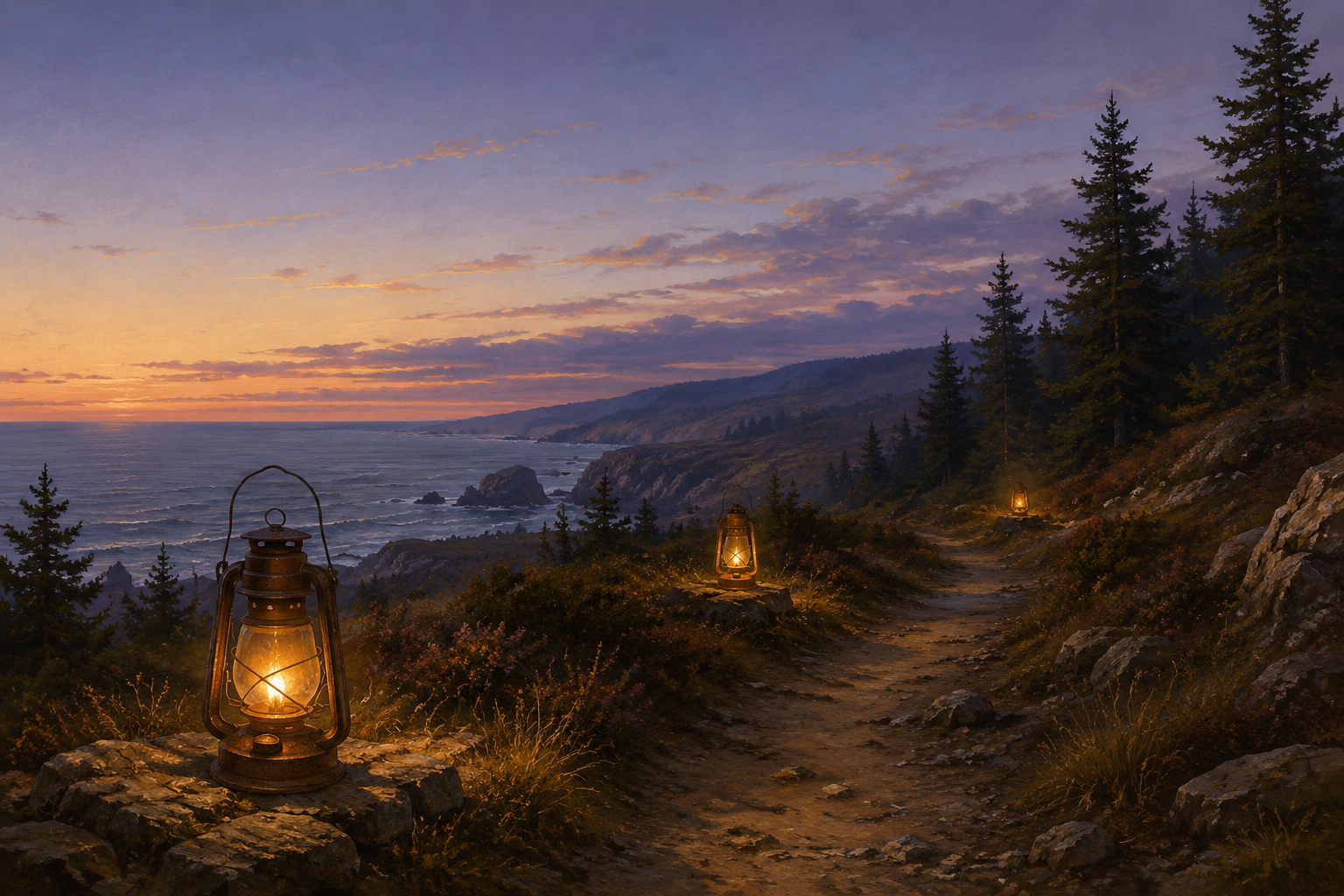
Sometimes a story knows how large it needs to be before the author does.
When I began The Founders’ Light, I envisioned one novel telling the story of Alderhaven’s founding. It would begin with Jonas Albright, a Massachusetts schoolmaster troubled by questions of character, community, and the obligations we owe one another. It would follow the pamphlet he wrote, the families who encountered his questions, their journey west, and the creation of the town readers first met more than 170 years later.
It seemed perfectly reasonable.
Then the founders began becoming people.
The Albrights, Whitfields, Marches, and Steeles did not simply read Jonas’s pamphlet and agree with it. They questioned it. They argued with it. They tested its ideas against the circumstances of their own lives. Each family brought a different concern to the conversation, along with children who were often less willing than the adults to accept an incomplete answer.
Their stories needed room.
More importantly, I began to realize that the founding of Alderhaven was not one story. It was three.
The first is the story of people finding one another.
These families live in different places and face different problems. They are not searching for a new town to establish, and Jonas has not written a plan for one. He has written questions. Those questions travel farther than he expects and reach households whose members begin to wonder whether other people are troubled by the same things they are.
Letters follow. Then visits. Eventually, the families gather in Ohio, where a catastrophe forces them to stop discussing community and begin creating one. For a brief time, they share their labor, shelter, food, judgment, and care with people who need them.
Only afterward do they recognize what they have done.
That realization gives the first book its natural conclusion.
The second story is the journey west.
By then, the families have chosen one another, but choosing shared principles is easier than preserving them through hunger, exhaustion, grief, danger, and disagreement. The overland journey will test not only their endurance but the beliefs that brought them together.
Can people remain faithful to their chosen character when survival makes compromise tempting?
Their arrival in Oregon will not end that test. They must choose a place, build their first shelters, and decide what the land—and an unexpected discovery beneath it—will require of them.
The third story begins when survival is no longer their only concern.
Alderhaven must become more than a camp belonging to four families. The founders will meet the Delgados and discover that a community needs more than conscience, endurance, memory, and responsibility. It must also possess the warmth that allows strangers to become neighbors.
New people will arrive. Some will enlarge the settlement. Others may threaten what its founders are trying to protect.
The people of Alderhaven will have to decide how a community can preserve its character without demanding that everyone share the same history, customs, temperament, or way of seeing the world. They must learn the difference between welcoming individuality and excusing conduct that harms others.
That question may be the most important one Jonas’s pamphlet never knew it was asking.
So The Founders’ Light is becoming a trilogy.
The decision was not made because I wanted to stretch one story across three books. It was made because the story had revealed three distinct journeys: finding one another, crossing the country together, and building a community capable of welcoming those who came afterward.
Each deserves its own trials, discoveries, losses, laughter, and conclusion.
I have spent years walking through the Alderhaven these families created. Now I have the privilege of discovering, one lantern at a time, how they found the road that led them there.
And I would love your help with one question:
If you could ask Alderhaven’s founders anything, what would you want to know?
I’d love to hear your question. You can send it to me at info@megrydercozy.com. It may help me discover something about them—or about the town they created—that I have not yet thought to ask.
If You Came to Alderhaven for a Day...
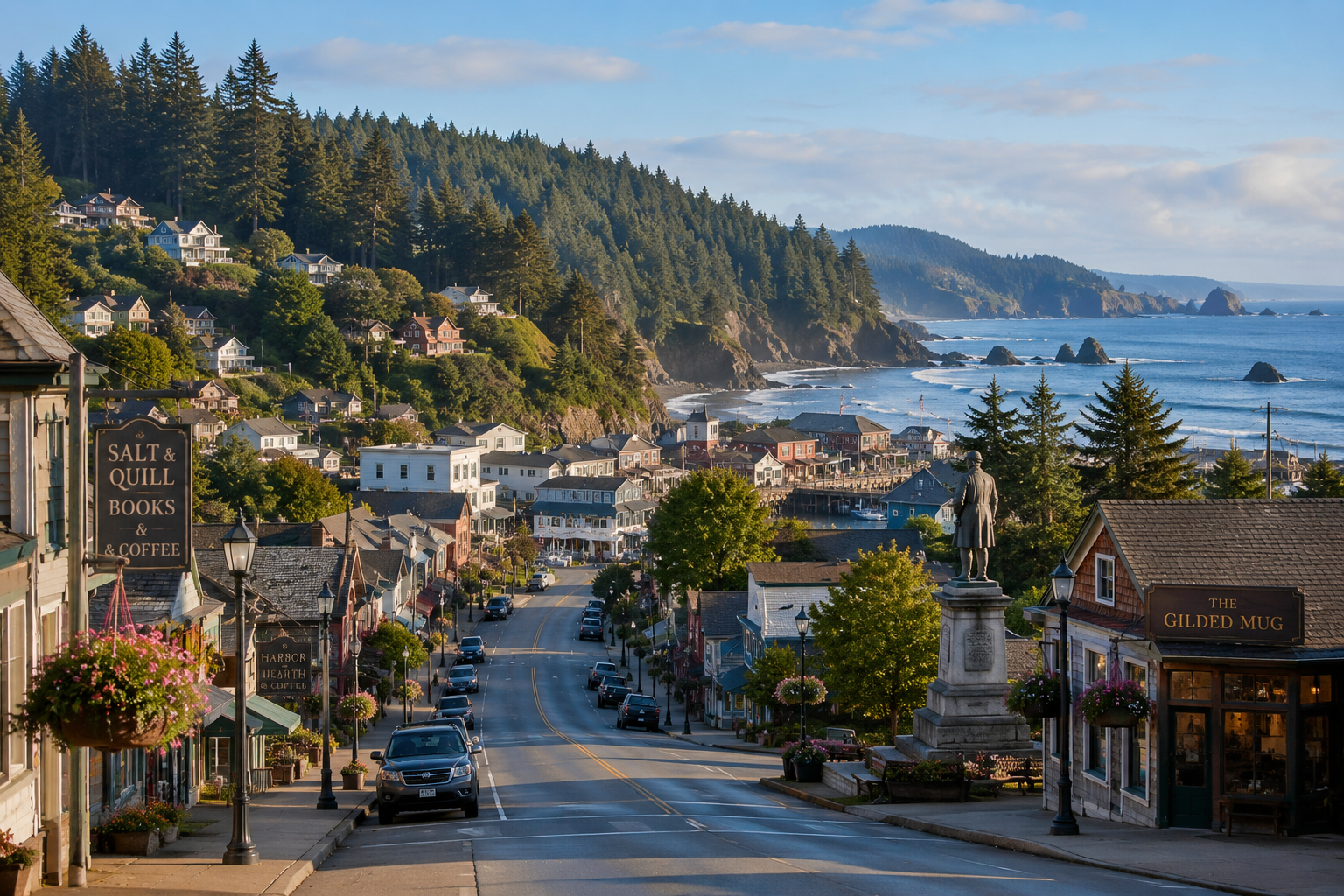
A view of fictional Alderhaven, Oregon, a small coastal town surrounded by evergreen forest and the Pacific Ocean.
If Alderhaven appeared on an Oregon map, you would probably have to look twice to find it.
It sits along the southern coast, where forest gives way to cliffs and the Pacific has spent centuries arguing with the shore. The population is somewhere around six thousand, though I suspect Marion Steele could tell you exactly how many people are home for supper on any given evening.
But suppose you found the road into town.
What would you do with one day?
Start at the Salt & Quill
You should probably begin with coffee.
Not because every cozy mystery requires caffeine, although there may be an argument for that, but because the Salt & Quill is one of the places where Alderhaven seems most like itself.
Part bookstore, part coffee shop, part unofficial gathering place, it is where Seraphina Beckett spends much of her time when she isn't asking questions someone would rather she leave alone.
If you're lucky, Sera will be behind the counter.
If you're very lucky, Simba will be asleep.
Simba is a Siamese cat who technically belongs to Sera. Simba has never acknowledged the technicality.
Choose your chair carefully. If he is already sitting in it, it is his. If he is looking at it, it is probably his. If he has ever considered sitting in it, negotiations may be difficult.
Take your coffee to a table and stay awhile.
Someone will come through the door.
It might be Marion Steele, who has reached the age where she no longer wastes time pretending not to know things. Marion has lived in Alderhaven most of her life, and if there is a difference between town history, town gossip, and information you probably weren't supposed to have yet, she has never found the distinction particularly useful.
Or Callie Monroe may appear, moving with the unconscious balance of someone who can get over, around, or across almost anything in her path. Don't underestimate her because she's young.
Actually, that's good advice for most of Alderhaven.
Then take a walk
Eventually you'll have to leave the Salt & Quill.
Simba may insist upon it.
Alderhaven is a walking town, and before long you'll find yourself near the statue of Jonas Albright.
Jonas was a Massachusetts schoolteacher who came west in the 1850s with his wife, Margaret, their five children, and some rather inconvenient ideas about how people ought to live together.
He wasn't alone.
Five families founded Alderhaven.
The Albrights. The Whitfields. The Marches. The Delgados. The Steeles.
Their descendants are still here.
So are some of their ideas.
I didn't fully understand how much those founders had shaped Alderhaven when I began writing the first Seraphina Beckett mystery. I knew the town was unusual. I knew its people valued independence, kindness, intuition, and the occasional refusal to do something merely because everyone else did it that way.
Only later did I begin asking the question Sera is now asking:
Where did those ideas come from?
I'm discovering the answer while writing The Founders' Light, a story about Alderhaven's five founding families, and I have a feeling Jonas and Margaret Albright still have a few things to teach me.
But we have only one day in Alderhaven, so we should keep moving.
Lunch is going to require a decision
You have choices.
You could stop at the Gilded Mug, where Delia March presides over coffee, conversation, and whatever else needs presiding over.
Or you could find your way to Harbor Hearth, where Tilda Gable understands one of the fundamental laws of small-town life: many problems become more manageable after someone has been fed.
Either way, don't be surprised if someone greets you before you've been properly introduced.
Alderhaven isn't unfriendly to strangers.
It simply hasn't decided you're a stranger for very long.
Spend the afternoon near the water
This is the part of Alderhaven I wish I could actually visit.
The town sits where the Oregon forest meets the Pacific, with cliffs, coves, paths, and places where the trees grow close enough to make the rest of the world feel farther away.
Walk toward the bluff.
Listen to the ocean.
Stay long enough and you may understand why Alderhavians have invented words for things the rest of us apparently decided didn't need names.
Quietgold is one of them.
There are others.
I've discovered that once a fictional town starts inventing its own vocabulary, the author has probably lost control of the situation.
I'm fine with that.
Alderhaven was never meant to feel like a town somebody designed.
It was meant to feel like a place that grew.
Stay until evening
This is when I think Alderhaven would be hardest to leave.
Shops begin closing. Lights appear in windows. Someone carries dinner across the street to someone who needs it. A conversation begun that morning is still unfinished somewhere else.
Sera may be back at the Salt & Quill.
Callie may be sketching.
Marion almost certainly knows what happened while you were gone.
And Sheriff Daniel Cross may appear, say very little, and somehow leave you with the impression that everything is under control.
You might notice something else by then.
Alderhaven isn't special because nothing bad happens there.
Bad things do happen.
People make mistakes. Families lose one another. Secrets survive longer than they should. People hurt one another, deliberately and accidentally.
What makes Alderhaven different is what happens afterward.
Again and again, its people ask some version of the same question:
What can we repair?
Sometimes the answer is a relationship.
Sometimes it's a wrong.
Sometimes it's a person who has spent too long believing she has nowhere to belong.
And sometimes the answer is simply dinner.
Before you go...
If Alderhaven were real, I think I'd tell you to stay another day.
There are roads you haven't taken yet. Stories you haven't heard. Five founding families we have barely begun to know.
And Simba still hasn't decided whether he likes you.
Alderhaven doesn't exist on an Oregon map.
But after three books, I'm no longer entirely convinced it isn't real.
And if you've spent a little time there with me, perhaps you aren't either.
Welcome to Alderhaven.
What Makes a Town Feel Like Home?
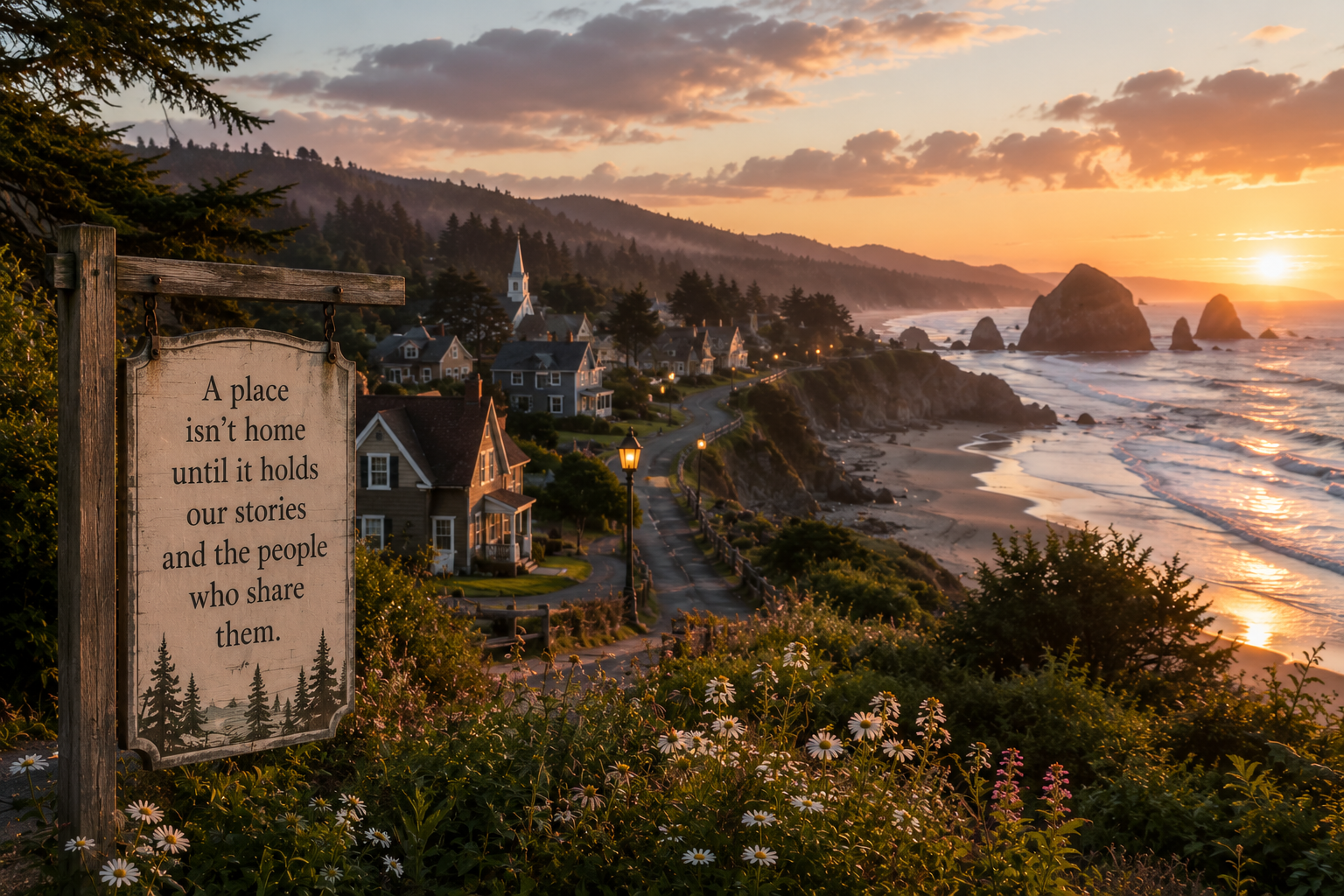
Some places stay with us long after we've left them.
It isn't always because of the scenery, though beautiful landscapes certainly help. Nor is it because every street is familiar. More often, it's because of the people we met there, the conversations we remember, and the quiet moments that somehow became part of our own story.
I've been thinking about that lately as I work on my next Alderhaven novel.
When I first imagined Alderhaven, I thought I was creating the setting for a mystery. Instead, I found myself asking a question.
What makes a place feel like home?
The answer surprised me.
It isn't the buildings.
It isn't the shops.
It isn't even the breathtaking Oregon coastline.
A town becomes home because of the people who choose to care for one another.
Home grows one act of kindness at a time. A neighbor bringing soup without being asked. Someone remembering your favorite table at the café. A friend who notices you're carrying more than you should and quietly offers to help. Those small moments rarely make headlines, yet they become the memories we carry for years.
The mysteries in the Seraphina Beckett series begin with unanswered questions, but they are really stories about people finding one another. Again and again, I've discovered that healing often begins long before the mystery is solved. It begins the moment someone realizes they no longer have to face life alone.
Perhaps that's why so many readers tell me they wish Alderhaven were a real place.
I smile every time I hear that.
Because in many ways, it already is.
It exists wherever people choose compassion over judgment, forgiveness over resentment, and community over isolation.
Thank you for spending a few minutes with me today.
I hope you've found a little corner of home in these pages.
Warmly,
Meg Ryder
Get to Know Seraphina Beckett
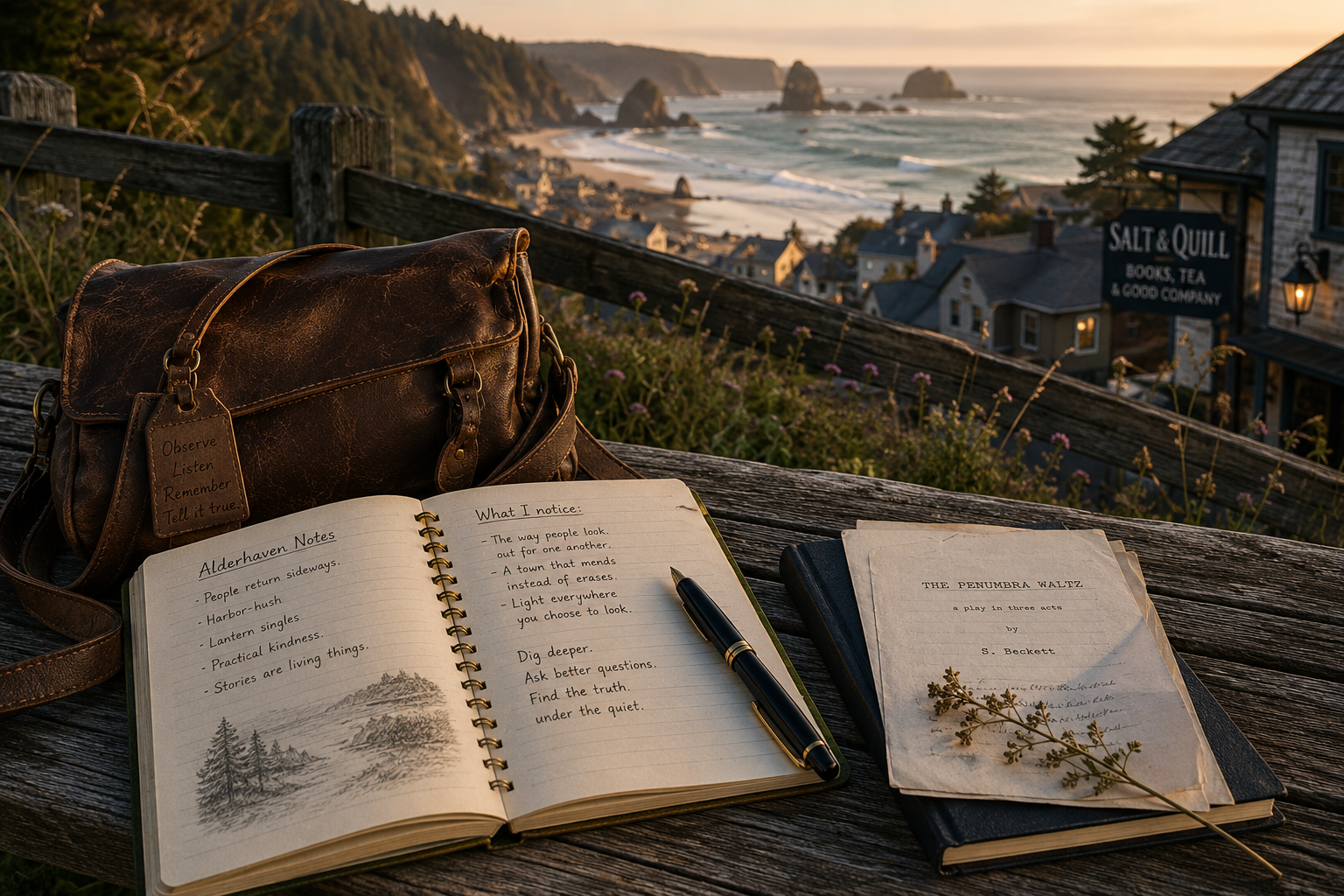
If you asked Seraphina Beckett, she'll tell you she didn't come to Alderhaven looking for a mystery.
She came looking for a place to breathe.
After years as a playwright in New York City—and consulting with the NYPD on criminal investigations—Sera arrives on the Oregon coast carrying more questions than luggage. She's talented, observant, and fiercely curious, but she's also quietly wondering what comes next when the life you've carefully built no longer feels like home.
Alderhaven wasn't supposed to be the answer.
But small towns have a way of finding people who need them.
As Sera settles into life above the Salt & Quill, she discovers that the town's greatest mysteries aren't always crimes waiting to be solved. Sometimes they're old friendships waiting to be restored, family histories hidden in forgotten journals, or a frightened teenager searching for a place where she finally belongs.
Those quieter mysteries are the ones that captured my heart while writing this series.
Sera notices details that other people overlook. She asks questions with kindness instead of suspicion. She's more interested in understanding people than judging them, and that often leads her to the truth long before everyone else arrives.
She's also wonderfully human.
She overthinks. She drinks too much tea while trying to untangle impossible puzzles. She doesn't always know what to say, but she keeps showing up for the people she loves. Like all of us, she's still learning that strength doesn't always look like certainty.
As the series continues, Sera discovers that Alderhaven is changing her every bit as much as she's changing it.
And perhaps that's the real mystery.
Not who committed the crime.
But how one small town teaches strangers to become family.
If you're just discovering Alderhaven, I hope you'll enjoy getting to know Seraphina Beckett. I certainly have.
Until next time,
Meg Ryder
Top 5 Cozy Mystery Tropes I’ll Never Get Tired Of

There are certain things cozy mystery readers expect—and let’s be honest, love. Some call them clichés. I call them comfort.
Whether it’s a nosy neighbor, a cat with opinions, or a suspiciously attractive barista, cozy mysteries have their own beloved rules—and I, for one, hope we never break them.
Here are my top five favorite cozy mystery tropes, in no particular order:
🧶 1. The Small Town with Big Secrets
Give me a village, a coastal town, or a sleepy hamlet that looks picture-perfect but harbors grudges, scandals, and skeletons in every closet. The real estate might be charming, but the gossip is lethal.
🐾 2. The Loyal Animal Companion
Readers of my Alderhaven stories already know that Simba has a remarkable talent for appearing exactly when he's needed.
💁♀️ 3. The Quirky Cast of Locals
The best cozies feel like you’re moving into town yourself. There’s the bakery owner with a suspiciously good memory, the librarian who’s definitely seen something, and the overly helpful neighbor who “just happened to be in the area.” Every one of them could be a suspect—or your new best friend.
🧩 4. The Puzzle-Box Plot
A cozy mystery isn’t just about whodunnit—it’s about how. I love a layered plot with hidden motives, clever misdirection, and that one clue hiding in plain sight. Bonus points if it involves a vintage teacup or an old journal.
☕ 5. The Sleuth Who Doesn’t Quit
She’s not a cop. She’s not supposed to be involved. But she can’t help it—because justice matters, and so do the people she’s come to care about. Whether she’s a bookseller, a baker, or a retired playwright, she’s sharp, stubborn, and someone I’d follow into any mystery.
What are your favorite cozy tropes? Did I miss one? Let me know in the comments—or better yet, tell me your favorite example from a book you love!
🕵️♀️ Until next time,
Meg Ryder
How I Named My Sleuth (Hint: It Was a Cat)

"Every cozy town deserves one observant cat."
How I Named My Sleuth (Hint: It Was a Cat)
There’s a lot that goes into writing a mystery. Twists, clues, red herrings, suspects, but one of the first and most important decisions? Naming your sleuth.
When I began sketching out the world for my cozy mystery series, I knew I wanted a heroine who was smart, creative, a little scarred, and a lot determined. I didn’t want her to be a cop or detective. I wanted her to be someone like us. So I gave her a name that felt timeless and just a bit theatrical: Seraphina Beckett.
“Seraphina” has an old-world elegance. It’s not overly common, but it lingers. It says, this person might surprise you. And “Beckett”? That’s a nod to the theater. (You’ll find quite a few stage-inspired breadcrumbs in her backstory.)
But the truth? The very first name that stuck wasn’t hers. It was her cat’s.
Simba, her blue-eyed Siamese with a sixth sense for danger, came to me long before I figured out the murder. He’s the one who mirrors her moods, warns her of shady suspects, and occasionally steals the scene.
So, in a way, it was Simba who named the sleuth. Because I needed someone who could match that energy—who could be clever but vulnerable, curious but not jaded. Someone who, like Simba, could trust her instincts.
Naming a sleuth isn’t just about sound. It’s about spirit. And once I found hers, the rest of the story started to fall into place.
Do you have a favorite fictional sleuth (human or feline)? Let me know in the comments!
🖋️ Until next time,
Meg Ryder
Welcome to the Blog
This is where I’ll occasionally share what’s brewing in the world of Meg Ryder — from behind-the-scenes peeks at upcoming mysteries to cozy recommendations and updates from Alderhaven.
I’m so glad you’re here. More posts coming soon!
What makes a Cozy Mystery?
🕵️♀️ What Makes a Cozy Mystery So...Cozy?
If you're anything like me, there's nothing better than curling up with a mystery that offers just enough suspense to keep you turning pages—but with characters you'd actually want to have tea with.
Cozy mysteries are a special kind of storytelling magic. The bodies may fall (gracefully, of course), but the stories always promise a sense of comfort, connection, and cleverness.
So what exactly makes a mystery cozy?
1. A charming setting
From coastal villages to bookshops, bakeries, and B&Bs, cozy mysteries often take place in places we’d happily move into—if not for the occasional murder. These settings aren’t just backdrops; they’re characters in their own right.
2. An amateur sleuth with heart
Whether it’s a former librarian, a quippy cat café owner, or a playwright-turned-bookstore-owner (hello!), cozy sleuths bring a unique perspective to their cases. They solve crimes not because it’s their job—but because they care.
3. Quirky side characters
Every cozy town comes with its fair share of gossip, grudges, and well-meaning meddlers. And let’s not forget the local law enforcement who alternately help and hinder the investigation.
4. A puzzle to untangle
There’s always a mystery worth solving—but without the gore or grit of darker crime fiction. Just enough clues, red herrings, and “aha!” moments to keep your brain ticking while your tea stays warm.
5. A touch of warmth (and often, whiskers)
Many cozies come with a cat, a dog, or another lovable companion. They’re not just cute—they often know who to trust before the humans do.
Whether you're a lifelong cozy reader or just discovering the genre, I’m so glad you’ve found your way here. My stories are filled with the things I love most: unexpected clues, heartwarming friendships, and a little light mischief served with your mystery.
Have a favorite cozy mystery series or sleuth? I’d love to hear about it in the comments!
🫖 Until next time,
Meg Ryder