I Planned One Story. Somehow, It Became Six Books.
When I first decided to tell the story of Alderhaven's founding families, I thought one book would be sufficient.
Looking back, I can only conclude that I hadn't yet met all the families.
I envisioned a novel exploring how a handful of people, living in different parts of nineteenth-century America, came to share a set of ideas about character, community, and the responsibilities we have toward one another.
I also wanted to follow Sera Beckett in modern Alderhaven as she uncovered the stories of the people who had built the town she now called home. Meanwhile, Callie would be finding her own way forward, gradually building relationships with the mother and grandmother she'd spent so much of her life without.
Two timelines. Several families. A considerable number of children. And, as it turned out, a great many opinions.
The characters had plenty to say.
And I kept listening.
As I developed the families, their histories, their relationships, and the circumstances that would eventually bring them together, it became apparent that one novel wasn't going to be sufficient.
So I decided to write a trilogy.
Three novels. Three substantial books. Surely that would provide enough room for everyone.
I was rather pleased with the arrangement.
Then I finished writing the first novel.
Apparently, my founding families hadn't received the message about reasonable limits.
The Moment of Reckoning
I use Atticus to prepare my books for publication. It allows me to arrange chapters, create front and back matter, and format a manuscript for both electronic and printed editions.
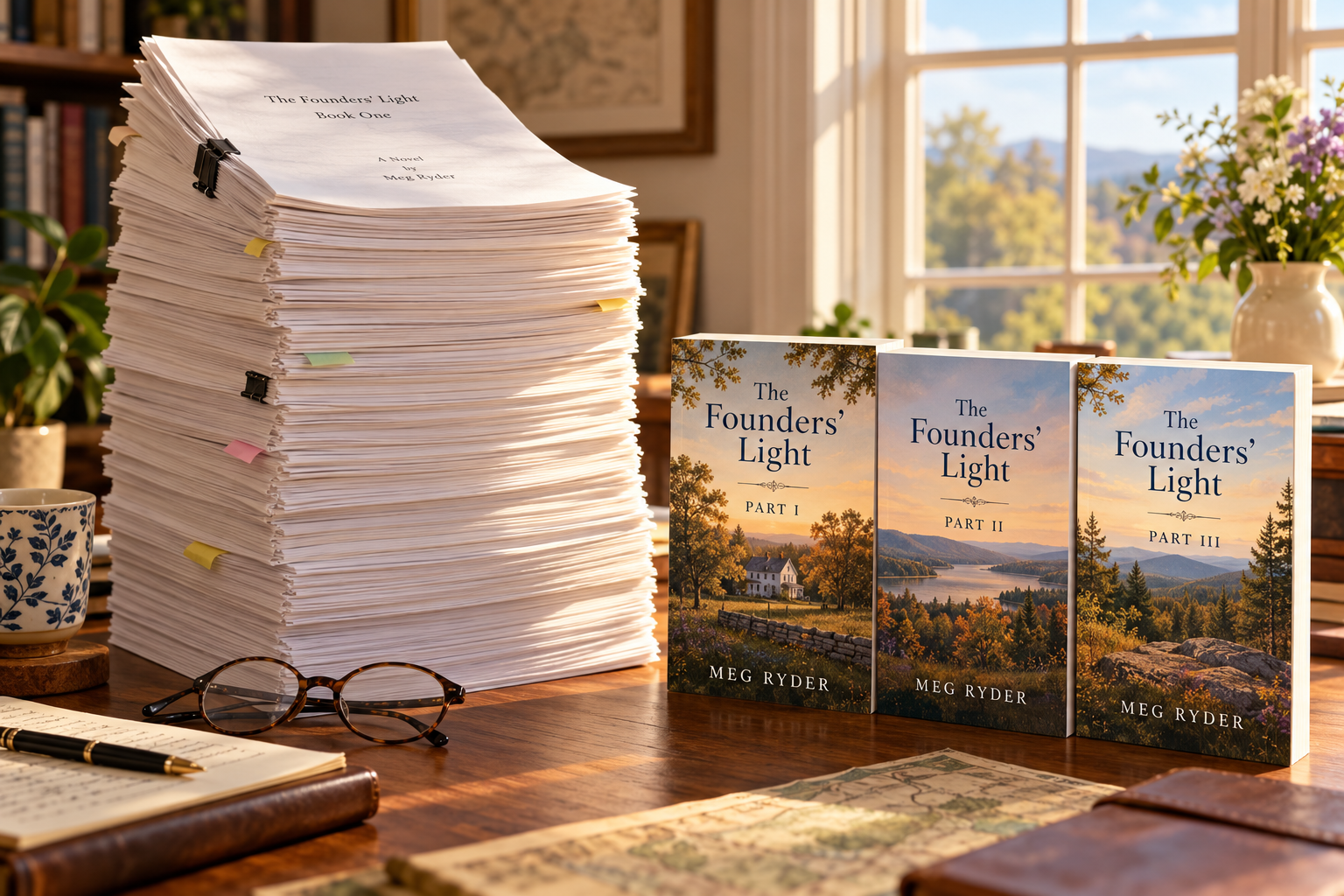
By the time I finished writing The Founders’ Light, the first novel in the trilogy, the manuscript had grown to more than 265,000 words.
That should probably have been my first warning.
When I asked Atticus to produce the print-ready file, the result was 1,694 pages.
I looked at the number for a while.
Then I looked at it again.
Apparently, the founders of Alderhaven had decided that if they were going to tell their story, they weren't going to be hurried through it.
I couldn't entirely blame them.
There are a good many people in this novel, and I've grown rather fond of most of them. Even the ones who occasionally make life difficult for everybody else.
But affection for one's characters doesn't solve the practical problem of producing a paperback with 1,694 pages.
And there was another difficulty. Amazon's Kindle Direct Publishing service, which I use to publish my paperbacks, has limits on how many pages a printed book can contain. At 1,694 pages, The Founders’ Light was well beyond those limits.
Even if I'd been willing to produce a book that might double as a doorstop, Amazon wasn't going to print it.
I briefly considered whether Victor Hugo might have been sympathetic.
Unfortunately, he wasn't available for consultation.
The Problem Wasn't Just the Length
There was an obvious solution, of course.
Make the print smaller.
Reduce the margins. Tighten the spacing. Squeeze more words onto every page.
But I've never liked reading books that require me to hold them at arm's length, adjust the lamp, and wonder whether I should have brought a magnifying glass.
Many of my readers are older adults, as am I. I want them to be comfortable reading my books.
And I don't think readers should have to struggle with the typography simply because an author has written a long story.
I could also have cut a substantial portion of the manuscript.
That deserved consideration. Every manuscript benefits from careful editing, and I've certainly spent enough time examining repeated words, unnecessary explanations, awkward dialogue, and passages that didn't quite accomplish what I intended.
But there is a difference between removing material that doesn't serve a story and removing material simply to make a book physically smaller.
The former improves a novel.
The latter doesn't necessarily do so.
I'd already spent a great deal of time revising The Founders’ Light. I wasn't convinced that eliminating whole sections would make it a better book.
And there was another consideration.
Getting to Know the Families
I should probably make one admission here.
I know The Founders’ Light is a long novel. Even divided into three paperback parts, it asks readers to spend a considerable amount of time with its characters.
But that was, in part, intentional.
Readers of The Sera Beckett Cozy Mysteries have had three novels in which to become acquainted with Sera, Callie, Marion, and the other people who make Alderhaven feel like a living community. They've come to know their personalities, their relationships, their strengths, and their occasional shortcomings.
I wanted readers to have that same opportunity with the founding families.
I didn't want Jonas and Margaret Albright, or the other parents, to be little more than names in a history book. And I certainly didn't want their children to become a collection of ages and birthdates, mentioned occasionally when the plot required another pair of hands.
I wanted readers to know these families as families: hear their conversations around the supper table, understand what concerned the parents, discover what delighted or frustrated the children, and watch relationships develop within and between households.
Because when these people eventually decide to undertake an extraordinary journey together, I want readers to understand not only what they're leaving behind, but who they are and why their choices matter.
That takes time.
Perhaps more time than I originally anticipated.
But I hope that by the time readers reach the end of Book Three, they won't feel they've merely learned how Alderhaven was founded.
I hope they'll feel they've come to know the people who made it possible.
One Novel, Three Paperbacks
So I began considering another possibility.
What if I kept the novel exactly as it was, but divided the printed edition into three manageable parts?
The more I thought about it, the more sensible it seemed.
The Founders’ Light follows a developing sequence of events. Its characters begin as strangers, discover shared concerns, form relationships, and gradually arrive at the possibility of building a different kind of life somewhere else.
The story has natural stages.
Why not allow the paperback editions to reflect them?
I could preserve the complete novel as a single ebook, where physical page count isn't an obstacle, and offer the printed edition in three parts.
No missing chapters.
No shortened conversations.
No children quietly disappearing from the narrative because their author needed to save forty pages.
That last consideration was particularly important. The founding families have enough children that keeping track of them has occasionally required something approaching a census.
And I wasn't about to tell one of them that there was no longer room in the book.
A Different Kind of Editing
Dividing a novel into three physical books involves more than separating chapters.
Each paperback needs its own cover and description. Each needs to make clear where it belongs in the reading order.
I also wanted a short note explaining the arrangement to readers.
That required a little thought.
I didn't want the explanation to sound as though I was giving readers instructions they hadn't requested. Nor did I want anyone to purchase Part II without realizing that Part I came first.
In the end, I decided that a straightforward explanation was best.
The novel had grown too long to publish comfortably as a single paperback in my chosen format, and I'd decided to preserve the story rather than reduce the type size or shorten the manuscript.
That's really all readers need to know.
There's also something satisfying about being able to say that the electronic edition contains the complete novel, while the paperback edition offers the same story in three volumes.
Readers can choose whichever format suits them.
And I can stop worrying about whether someone might need a reinforced bookshelf.
What Happens to Books Two and Three?
I'm planning for Book Two to be shorter, with a little more suspense and a quicker pace.
After all, the families have spent much of Book One discovering one another, exploring the ideas that brought them together, and gradually coming to the realization that they might want to build a different kind of life somewhere else.
In Book Two, they'll have to turn that possibility into a practical undertaking. And I suspect the nineteenth-century American frontier will provide plenty of opportunities for excitement.
Book Three, however, is another matter.
That novel will follow the families as they begin building the community that eventually becomes Alderhaven. There will be homes to construct, problems to solve, disagreements to resolve, and newcomers to welcome.
I'm hoping to keep it to a reasonable length.
Of course, I was hoping that when I began Book One.
So although my original plan for one story has expanded into a trilogy that may require six paperback volumes, I should probably add a small disclaimer:
The author cannot be held responsible if the founding families decide that Book Three requires three volumes of its own.
At this point, I've learned that it's generally wiser to let them finish telling their story before making any further predictions about its length.
One More Book That Isn't Quite a Novel
There's another small publishing project growing out of The Founders’ Light.
At the heart of the story is a pamphlet written by Jonas Albright, a Massachusetts schoolteacher whose ideas about character and human responsibility eventually help bring the founding families together.
The pamphlet is called An Inquiry into Character.
While writing the novel, I decided that Jonas ought to have written the actual essays, rather than merely having other characters discuss them.
So he did.
Or, more accurately, I did, with a good deal of assistance from Jonas.
The result is sixteen essays that explore the questions underlying the story.
The complete pamphlet will appear in the final paperback part of The Founders’ Light, but I'm also preparing it as a separate complimentary publication for readers who might enjoy spending a little more time with Jonas's ideas.
It seems only fitting that a pamphlet responsible for bringing fictional families together should be allowed to travel beyond the pages of the novel.
The Story Hasn't Changed
The most important thing about this publishing decision is what hasn't happened.
The characters haven't lost their voices.
The families haven't been hurried through their decisions.
The journey hasn't become shorter simply because the printed book became too long.
And the story I wanted to tell is still the story readers will receive.
I've learned a great deal while writing The Founders’ Light, much of it about nineteenth-century life, and some of it about my own habits as a writer.
Now I've learned something about publishing, too.
Sometimes the answer to a problem isn't to make the story smaller.
Sometimes it's simply to give the story more than one cover.
I'm beginning to understand why the founders wanted their own town.
Apparently, they needed the room.