
When A Finished Book Isn't Finished
When a Finished Book Isn’t Finished
I thought The Vanishing Road was finished.
The story had a beginning, a middle, and an end. The mystery had been solved. The characters had survived what I put them through. I had read the manuscript more than once and made corrections along the way.
All it needed, I thought, was one final read-through.
That was several weeks and a great many corrections ago.
The trouble began when I noticed a phrase I had used several times. It wasn’t a bad phrase. In fact, I must have liked it very much because I kept using it. Something would be said, and then the meaning would “settle” over the room. A thought would “land.” A silence would become significant.
After a while, I began to suspect that nothing in Alderhaven could happen without settling somewhere.
Once I noticed that habit, I started finding other things.
A character left the Salt & Quill and suddenly appeared outside without walking to the door. Another character spoke during a scene even though she wasn’t there. Someone answered a question that no one had asked.
Then there were the characters who knew things they had not yet learned.
Callie’s story made this especially important. She remembers very little about her early childhood. That means I have to keep careful track of every name, place, and relationship she discovers. She cannot talk about someone before she knows that person exists. She cannot remember being sent away if she does not even know for certain that she once lived in Alderhaven.
Unfortunately, Callie occasionally knew more than she was supposed to know.
Perhaps she had read ahead.
Continuity problems appeared in less mysterious forms too. Five parkour lessons began sounding as though they had all happened after only one. Travel plans did not allow enough time for passports to arrive. People started conversations in one place and seemed to finish them somewhere else. At one point, France became Paris even though everyone was still in Honfleur.
No wonder the characters were tired.
I also discovered entire conversations that repeated information from the previous chapter. Sometimes the wording was nearly identical. Apparently, everyone in Alderhaven wanted to be certain they had been heard.
Removing those repetitions made several chapters much shorter. That worried me at first. A chapter that had looked quite respectable suddenly appeared to have missed several meals.
But a longer chapter is not necessarily a better chapter. If two scenes accomplish the same thing, keeping both does not give the reader more story. It only makes the reader travel the same road twice.
The solution wasn’t simply to cut. Once the repeated material was gone, I could see where something useful was missing. A conversation needed more warmth. A transition needed to show how someone got from the bookstore to the street. Sera and Cross needed to say what they meant instead of relying on Sera to understand everything from one raised eyebrow and a pause.
Some chapters became shorter. Others grew again because the characters finally had room to talk.
Then Chapter 23 disappeared.
I do not mean that I accidentally deleted a sentence or misplaced a paragraph. I somehow lost the entire chapter while I was working in it.
My fingers have talents I do not fully understand.
Fortunately, another copy existed, and the chapter was reconstructed. I reviewed it, corrected it, and then reviewed it again. By now, every chapter in The Vanishing Road has learned that claiming to be finished will only attract further attention.
We have five chapters left to examine.
I would like to say confidently that when those five are done, the book will finally be finished. Experience suggests that such a statement would cause three duplicated paragraphs, an unexplained change of location, and a missing Tuesday to appear immediately.
So I will say only that we are getting closer.
The manuscript is becoming leaner, clearer, and more faithful to the people in it. Callie knows what she should know when she should know it. Sera and Cross are communicating like two intelligent adults instead of participants in an advanced intuition contest. Honfleur has remained in France. And, so far, every chapter is accounted for.
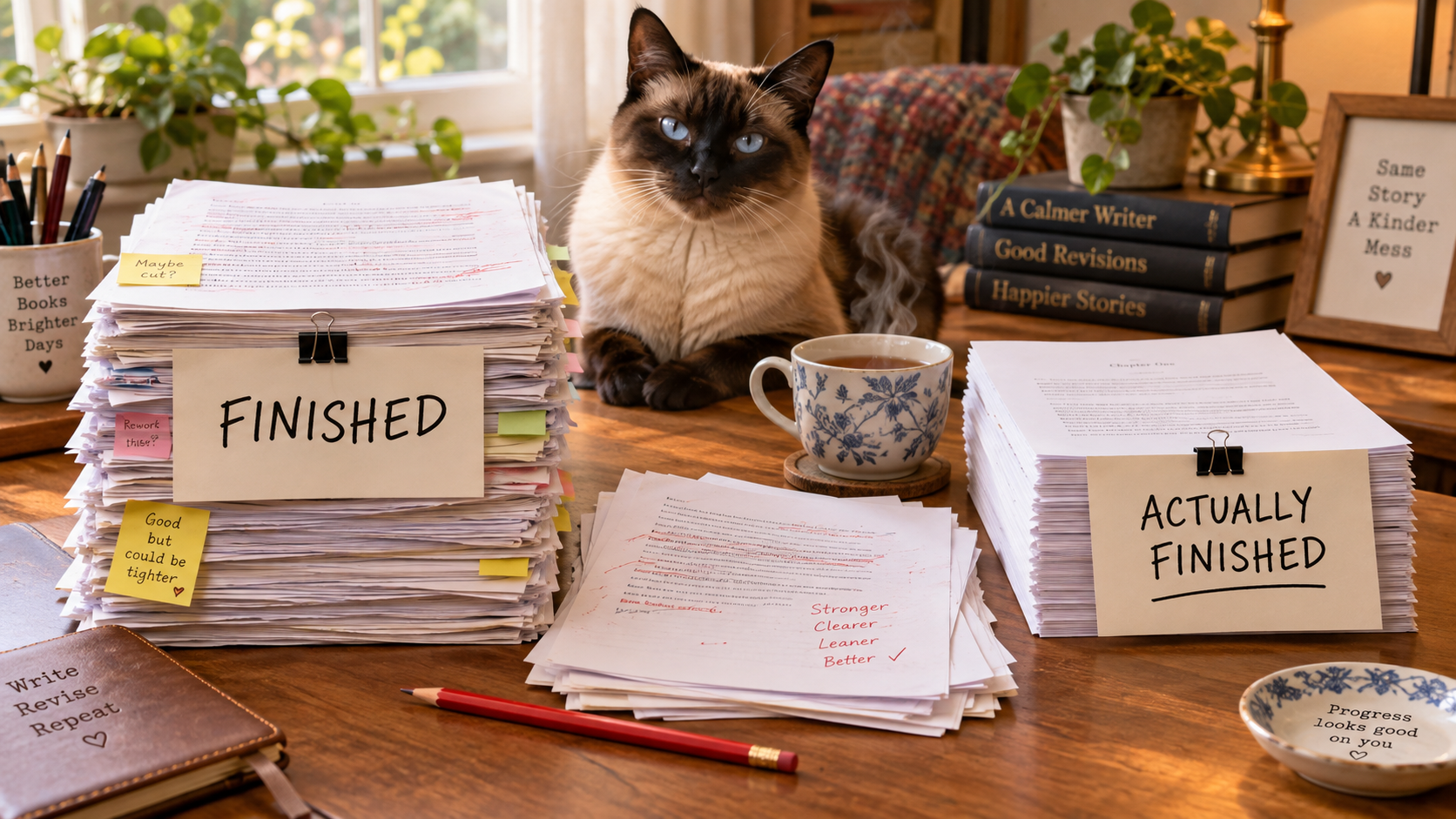
Simba, of course, has supervised the entire process. Judging by the photograph, he believes all successful revisions should produce a smaller stack of pages and a larger space for the cat.
He may be right.
Have you ever finished something, felt pleased with it, and then discovered it wasn’t quite finished with you? I’d love to hear what happened. You can share your story with me at info@megrydercozy.com. Perhaps we can reassure each other that “finished” is sometimes more of a hopeful suggestion than a fact.