
I have just finished Book 1 of The Founders’ Light, and I can report that keeping track of a fictional household can be surprisingly demanding.
You might think the difficult questions would all be large ones. What makes people trust one another? What persuades a family to consider a different future? How do strangers begin to discover that they share something important?
Those questions matter. But sometimes, before I can get back to them, I have to work out where everyone is going to sleep.
The Albrights have five children and a modest home. When visitors arrive, hospitality requires more than opening the door and putting another plate on the table. Someone has to give up a bed. Someone has to find room for bedding. And a small child cannot simply appear in the loft because it happens to be convenient for the sentence I’m writing.
Children, I have discovered, need supervision even when they exist only on paper.
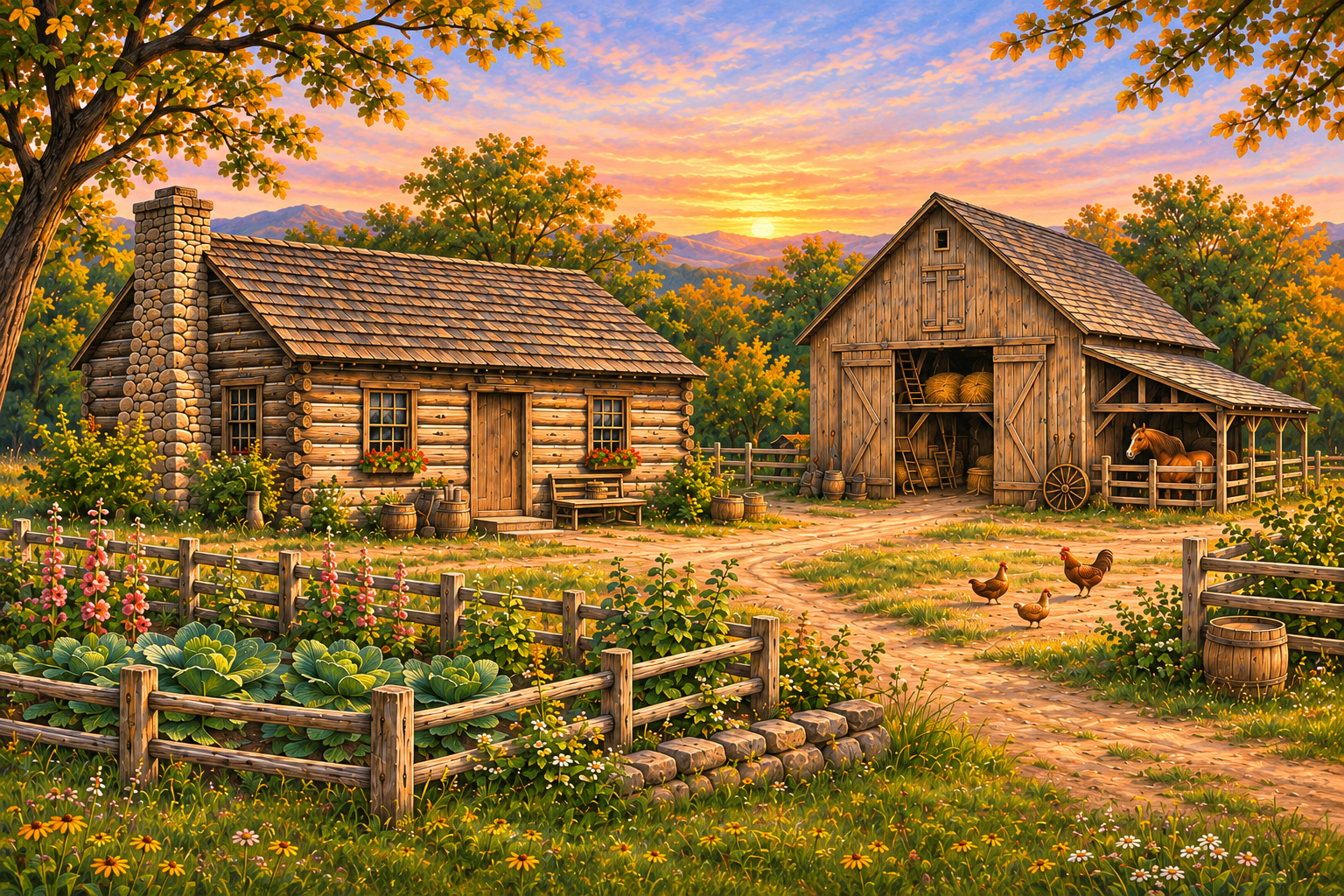
The homestead pictured here helped me think about the family’s daily life. There is the house, with the barn nearby, the vegetable garden, and the yard between them. It looks peaceful in the evening light. Margaret Albright could probably supply a fairly substantial list of things that still needs doing.
A garden means food, but it also means planting, weeding, watering, and harvesting. Visitors mean welcome company, but they also mean more meals and more washing. Those practical details give the family’s kindness a cost. Making room for someone matters more when there isn’t much room to begin with.
Jonas’s pamphlet brought another set of small questions.
Writing down his ideas was only the beginning. Paper had to be bought. Printing had to be paid for. Copies had to reach the people who might read them. A sentence about sharing an idea can be quite brief; the work of getting that idea into another person’s hands takes considerably longer.
I don’t want readers to feel they have wandered into an account book. But I do want the family’s choices to feel as though they belong to the life they are living.
Then there are the birthdays.
A child who is six in one chapter cannot become eight a few months later merely because I need him to reach something. Names, ages, seasons, and family relationships all have to hold together. My characters may not know what is coming next, but I ought to know how old they are when it happens.
Much of this work should pass unnoticed in the finished book. Readers have come for the people and their story. They shouldn’t have to stop and wonder how a house acquired an extra bedroom or whether a younger child has somehow overtaken an older sibling.
I hope they will feel the result: a household with familiar routines, work waiting to be done, children underfoot, and people willing to inconvenience themselves for one another.
Looking back over this first book, those are some of the details I’m most fond of. The larger story grows out of them—out of meals prepared, letters sent, expenses considered, and a place made for a guest.
And, eventually, somewhere for everyone to sleep.
When you read, what small details make a fictional home or town feel real to you?